


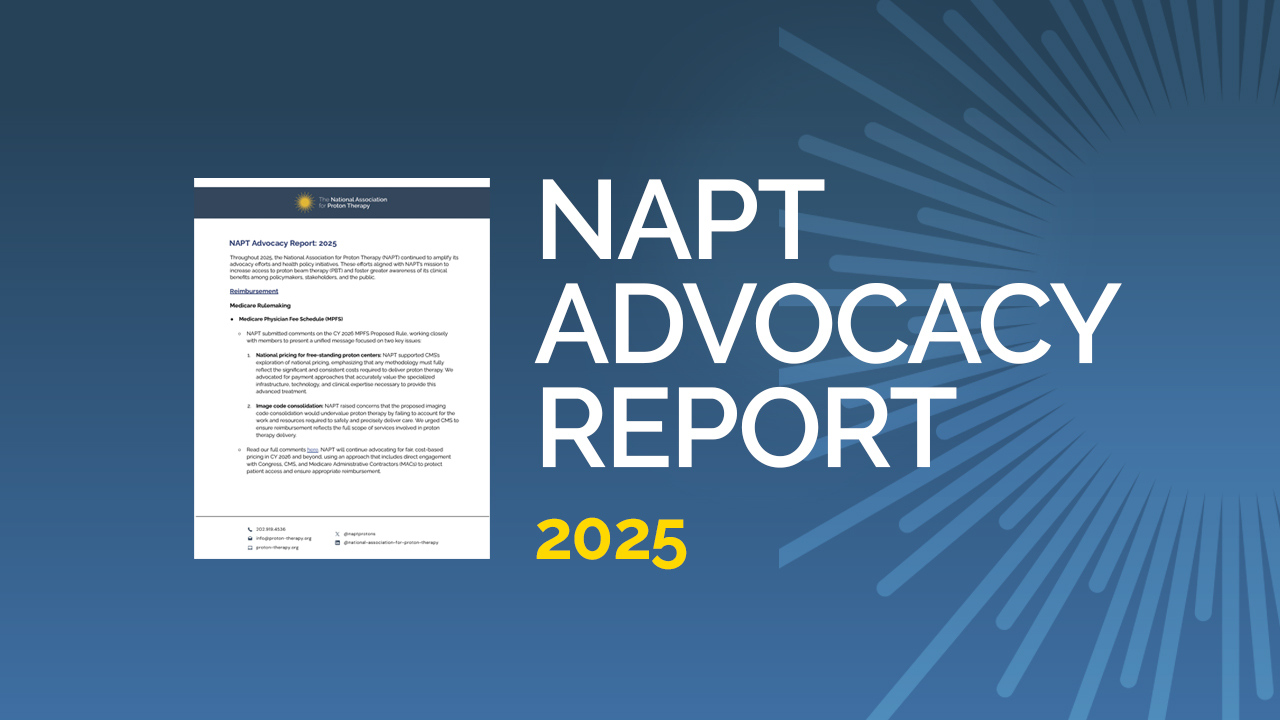
Throughout 2025, the National Association for Proton Therapy (NAPT) continued to amplify its advocacy efforts and health policy initiatives. These efforts aligned with NAPT’s mission to increase access to proton beam therapy (PBT) and foster greater awareness of its clinical benefits among policymakers, stakeholders, and the public.
Reimbursement
Medicare Rulemaking
- Medicare Physician Fee Schedule (MPFS)
-
- NAPT submitted comments on the CY 2026 MPFS Proposed Rule, working closely with members to present a unified message focused on two key issues: 1) national pricing for free-standing proton centers, and 2) image code consolidation.
-
-
- National pricing for free-standing proton centers: NAPT supported CMS’s exploration of national pricing, emphasizing that any methodology must fully reflect the significant and consistent costs required to deliver proton therapy. We advocated for payment approaches that accurately value the specialized infrastructure, technology, and clinical expertise necessary to provide this advanced treatment.
- Image code consolidation: NAPT raised concerns that proposed imaging code consolidation would undervalue proton therapy by failing to account for the work and resources required to safely and precisely deliver care. We urged CMS to ensure reimbursement reflects the full scope of services involved in proton therapy delivery.
-
-
- Read our full comments here. NAPT will continue advocating for fair, cost-based pricing in CY 2026 and beyond, using an approach that includes direct engagement with Congress, CMS, and Medicare Administrative Contractors (MACs) to protect patient access and ensure appropriate reimbursement.
- Hospital Outpatient Prospective Payment System (OPPS)
-
- Throughout 2025, NAPT educated members on cost reporting and charge structures to ensure proton therapy costs are accurately reflected in the OPPS methodology. When CMS released the CY 2026 OPPS Proposed Rule in July, proton therapy codes experienced a rate increase.
Medicare Administrative Contractors (MACs)
NAPT monitors and engages with MACs to ensure fair and sustainable reimbursement for proton therapy and coverage guidelines. As MACs play a critical role in setting regional payment rates and Local Coverage Determinations (LCDs), we are engaging with key decision-makers to address concerns over rate variability and to mitigate reductions that could threaten patient access to proton therapy. By providing data-driven insights and working alongside our members, NAPT continues to advocate for payment structures that accurately reflect the costs of delivering high-quality proton therapy.
Coverage
United Settlement
In December, a federal court approved a nationwide settlement in Weissman v. UnitedHealthcare, resolving long-standing litigation over coverage denials for proton therapy. Under the settlement, UnitedHealthcare will revise its coverage policy, remove language labeling the treatment as experimental, and require individualized medical-necessity reviews that consider treating-physician recommendations. The agreement marks an important step toward more consistent, evidence-based coverage and improved patient access.
Medicare Advantage
NAPT has contributed comments that led to strengthened Medicare Advantage (MA) coverage for proton therapy. Building on prior CMS comment letters, NAPT successfully elevated concerns around prior authorization, plan variation, and lack of alignment with Medicare coverage rules. CMS incorporated new expectations for MA plans to better align with LCDs and improve transparency in prior authorization, reflecting a clear win for patient access and NAPT’s sustained engagement. Read our 2023 comments here.
Prior Authorization
Seniors’ Timely Access to Care Act
As a member of the Regulatory Relief Coalition (RRC), NAPT continues to support the Improving Seniors’ Timely Access to Care Act (S. 1816 / H.R. 3514), which seeks to streamline and modernize the prior authorization process for Medicare Advantage plans. Download a fact sheet and find other information here. There is currently no timeline for Congressional action on this bill.
Industry Pledge
Health and Human Services (HHS) Secretary Robert F. Kennedy, Jr. and Centers for Medicare & Medicaid Services (CMS) Administrator Dr. Mehmet Oz met with industry leaders in June to discuss their pledge to streamline and improve the prior authorization processes for plans covering nearly eight out of 10 Americans. Read a summary here.
Federal Legislation
Radiation Oncology Case Rate (ROCR) Act
The Radiation Oncology Case Rate (ROCR) Act (S.1031 / H.R.2120) was reintroduced in March to establish a mandatory radiation oncology case-rate value-based payment program. Learn more here.
NAPT worked closely with the American Society for Radiation Oncology (ASTRO) and Senator Thom Tillis’ office to ensure fair reimbursement for proton therapy. Through NAPT advocacy, inclusion of proton therapy in the model was delayed from 10 to 12 years, and language was incorporated ensuring proton therapy is treated consistently with other excluded or emerging technologies. While NAPT’s proposal to establish an alternative payment methodology was not included, the association remains committed to advancing payment reforms that accurately value proton therapy. There is currently no timeline for Congressional action on this bill.
State Legislation
In June, Louisiana passed Senate Bill 129, requiring health insurers to cover proton therapy for cancer treatment when recommended by the American Society for Radiation Oncology (ASTRO) practice guidelines. The law, championed by NAPT member Willis Knighton Health, applies to health plans issued on or after January 1, 2026, and existing plans must comply by their renewal date or by January 1, 2027. This legislation marks a significant step toward ensuring consistent, guideline-based access to proton therapy for cancer patients across the state.
On the Hill
In March, NAPT met with key Congressional offices and committee staff to advocate for policies that protect and expand access to proton therapy. Discussions focused on improving reimbursement and coverage, with an emphasis on proton therapy’s benefits for complex and pediatric cases and the growing evidence base supporting its use.
FDA Commissioner Highlights Proton Therapy
At a May MAHA Commission event hosted by President Donald J. Trump at the White House, newly appointed FDA Commissioner Dr. Marty Makary praised the role of proton therapy in U.S. healthcare innovation. In his remarks, Dr. Makary stated, “The United States is best in the world when it comes to proton beam therapy, CAR-T, and sophisticated operations…” These comments highlight growing national recognition of the importance of proton therapy as a cornerstone of advanced cancer treatment. Watch the full video here.
Excellence Awards
NAPT honors individuals who have made outstanding contributions to advancing proton therapy through the Champion Award and Patient Advocate Award.
- Champion Award, 2025 Winner: Bill Thomas
Bill Thomas, Associate Vice President at Hampton University, led major advocacy efforts to expand access to proton therapy in Virginia. His work has helped secure key policy wins benefiting patients at Hampton and beyond.
- Patient Advocate Award, 2025 Winner: Denise Durgin
Denise Durgin, a patient at the Maryland Proton Treatment Center, has become a leading voice for proton therapy through her book Prescription for Proton Therapy, public speaking, and advocacy on Capitol Hill.
Read more on the Excellence Awards here and nominate for 2026.
Looking Ahead to 2026
As we look ahead to the new year, key priorities include payment stability, prior authorization, and patient access. NAPT will continue working to safeguard patient access and promote equitable policies in these evolving areas. Check our advocacy page for further updates.
DOWNLOAD A PDF OF THE REPORT HERE